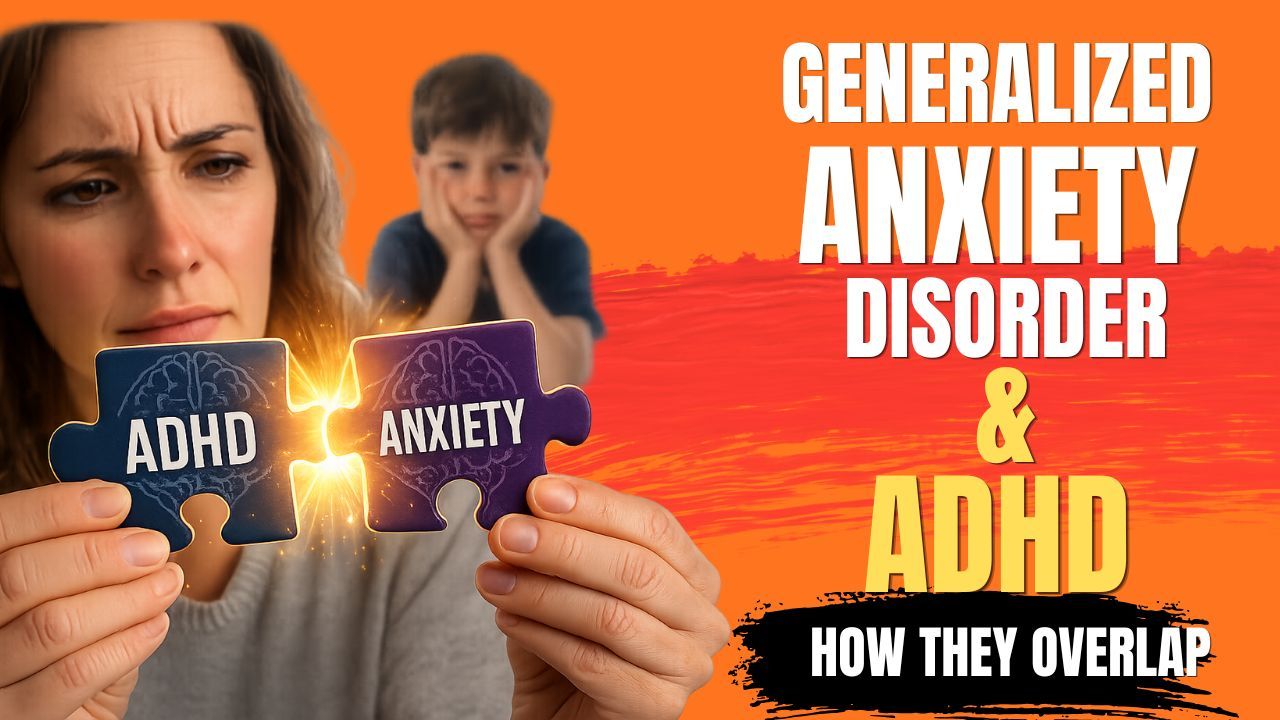
Generalized anxiety disorder and ADHD—how they overlap
Jun 25, 2026When parents are trying to understand generalized anxiety disorder and ADHD, one of the hardest things is figuring out what's really going on with their child.
Maybe they're struggling to focus. They're restless, emotional, forgetful, or overwhelmed. You want to help—but you're left wondering:
Is this ADHD? Is it anxiety? Or could it be both?
The truth is that ADHD and anxiety share many similar behaviors. From the outside, they can look almost identical. The key difference isn't always what your child is doing—it's why they're doing it.
Understanding those underlying patterns can help you respond with greater confidence and choose the support that fits your child best.
Why Generalized Anxiety Disorder and ADHD Can Look Similar
Generalized Anxiety Disorder and ADHD both affect concentration
Both ADHD and anxiety can make it hard for a child to stay focused, but for different reasons.
With ADHD, attention naturally shifts from one stimulus to another. The brain is constantly noticing new information, making it difficult to stay with one task for long.
With anxiety, attention becomes trapped by worry. Thoughts circle around fears, uncertainty, or "what if" scenarios, leaving little mental space for anything else.
The behavior may look the same, but the mental experience is very different.
If you're noticing ongoing attention challenges, you may also find our guide on ADHD Assessment for Teens: What Parents Need to Know helpful when considering whether a professional evaluation is appropriate.
For a deeper understanding of how anxiety affects thinking and concentration, you can also explore Generalized Anxiety Disorder in Children .
Understanding difficulty concentrating with Generalized Anxiety Disorder and ADHD
Children with ADHD often appear to be in constant motion. They may fidget, get up frequently, or struggle to sit through activities like movies or long conversations because they're seeking stimulation.
Children with anxiety can also seem restless, but their movement is often driven by physical tension. Instead of looking for something more engaging, they're trying to relieve the uncomfortable feeling of worry inside their bodies.
Both children may pace or fidget, but one is seeking stimulation while the other is seeking relief.
Generalized Anxiety Disorder influences racing thoughts differently
A busy mind is common in both conditions.
With ADHD, thoughts often jump rapidly from one topic to another. Ideas, memories, and distractions compete for attention.
With anxiety, thoughts usually stay focused on a single concern. The mind repeatedly returns to possible problems or future situations, making it difficult to let them go.
One mind is constantly changing channels.
The other is stuck replaying the same one.
ADHD affects procrastination in its own way
When a child avoids starting something, it's helpful to ask what's driving the avoidance.
For ADHD, distractions often pull attention toward activities that feel more interesting or rewarding.
For anxiety, the task itself may feel overwhelming or intimidating. Fear of making mistakes or not doing it well can make getting started feel incredibly difficult.
The same behavior can have very different causes.
Sleep Difficulties
Sleep struggles are common in both ADHD and anxiety.
Children with ADHD may find it difficult to "turn off" their brains. Thoughts continue moving even after the day has ended, or they may wake during the night with an active mind that won't settle.
Children with anxiety often struggle because worry keeps them alert. Concerns about tomorrow or imagined future problems make relaxing enough to sleep difficult.
In both cases, poor sleep can lead to fatigue, irritability, and difficulty concentrating the next day.
Emotional Overwhelm
Many children with ADHD experience emotions very intensely.
They may react strongly to criticism or feel deeply hurt by perceived rejection. This experience, often called Rejection Sensitive Dysphoria (RSD), can make even small comments feel incredibly personal.
At the same time, these children often experience positive emotions just as intensely, allowing them to develop tremendous empathy and compassion.
Children with anxiety also experience emotional overwhelm, but it is usually fueled by persistent worry and a heightened stress response.
Although generalized anxiety disorder and ADHD can produce similar behaviors, the underlying causes are often very different.
Both children may appear emotionally flooded, but the source of that overwhelm is different.
If emotional reactions are becoming difficult to manage at home, our article ADHD Emotional Regulation Strategies for Your Teens Love Language offers practical ideas for supporting emotional regulation.
You may also want to learn more about Executive Function and Emotional Regulation .
Forgetfulness and Mental Blanking
Have you ever walked into a room and forgotten why?
Both ADHD and anxiety can create moments like this.
With ADHD, working memory challenges make it difficult to hold information in mind while completing tasks.
With anxiety, stress consumes mental resources, making it harder to retrieve information or stay mentally organized.
The result may look identical, but the brain is working against different challenges.
Feeling Like Everything Is "Too Much"
Children with ADHD can become overstimulated by noise, emotions, activity, or even their own thoughts. Once they reach that point, everything may suddenly feel overwhelming.
Children with anxiety often become hypervigilant. Their nervous system stays alert for possible danger, making everyday situations feel exhausting.
Both experiences are very real—and both deserve understanding rather than judgment.
Looking at the Bigger Picture
When you're trying to understand your child, don't focus only on the behavior.
Ask yourself:
- Is my child's attention constantly bouncing from one thing to another?
- Or are they getting stuck on worries and fears?
- Are they seeking stimulation?
- Or are they trying to reduce anxiety?
These questions often reveal more than the behavior itself.
It's also important to remember that ADHD and anxiety frequently occur together. Many children experience both, which is why a thoughtful evaluation is so valuable.
If your child often feels overwhelmed, our article ADHD Parenting: The Essential Guide for Overwhelmed Moms provides additional strategies for creating a calmer home environment.
To better understand the differences between ADHD and anxiety, consider reading about The Difference Between ADHD and Anxiety in Children.
When to Seek Professional Support
Understanding your child is one of the greatest gifts you can give them.
When you recognize what's driving their behavior, you're able to respond with greater patience, choose more effective strategies, and create an environment where they can truly thrive.
Ready to Gain More Clarity?
If you're unsure whether you're seeing ADHD, anxiety, or both, I'd be happy to help you gain clarity.
Let's schedule a brief 10–15 minute clarity call to talk through your child's challenges and explore practical next steps. Sometimes a simple conversation can provide the understanding that changes everything.
You don't have to figure everything out on your own. With the right support and a clear understanding of your child's unique needs, you can move forward with confidence.
Connect with me and find out how my Emotionally Empowered Parent Coaching Program can help you to success and calm in your parenting of teens with ADHD
Stay connected with news and updates!
Join our mailing list to receive the latest news and updates from our team.
Don't worry, your information will not be shared.
We hate SPAM. We will never sell your information, for any reason.
