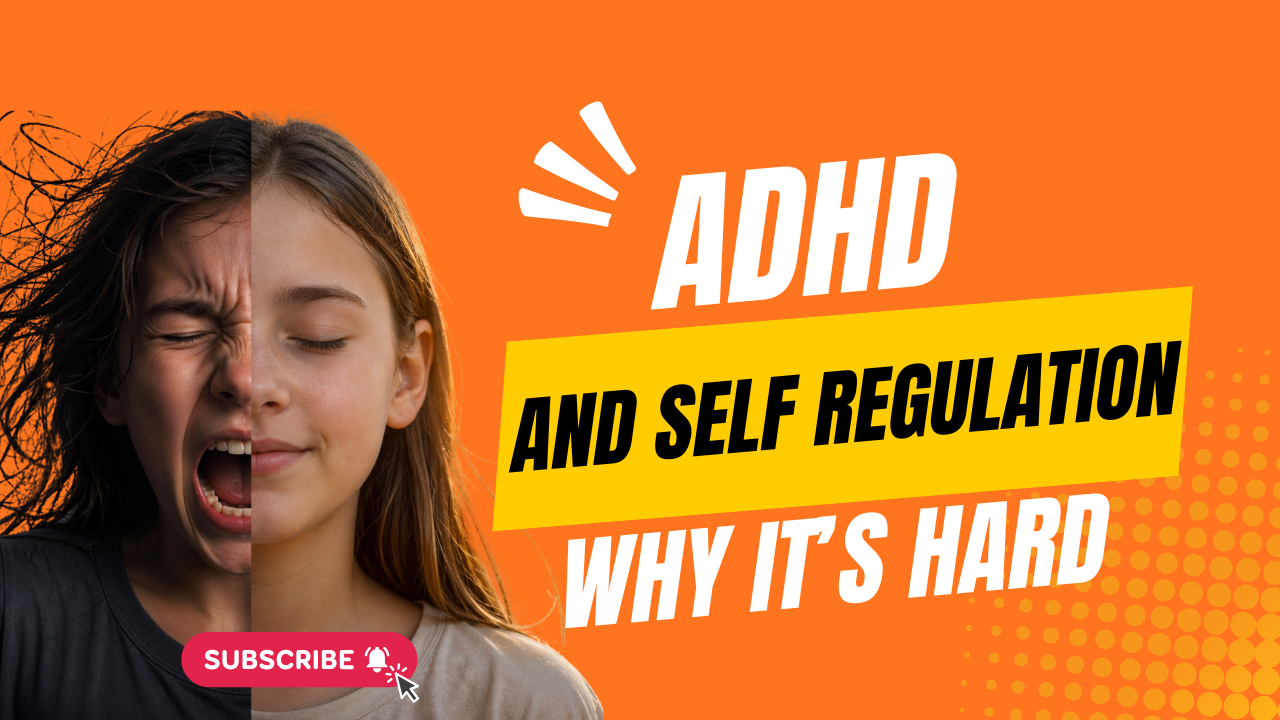
ADHD and self regulation—why it’s hard
Apr 29, 2026If you’ve ever found yourself—or your child—stuck in a loop of trying to get something done but somehow never getting there, you’re not alone.
ADHD and self regulation challenges often show up exactly like this.
You start with a clear intention.
You even make a plan.
And then… life happens.
Distractions creep in. One thing turns into five.
Hours pass.
And somehow, the most important task never gets finished.
It’s frustrating. Confusing. And often, it leads to a deeper question:
“What’s actually going on here?”
Understanding ADHD, focus, and executive function challenges
ADHD and self regulation help explain daily struggles
I was speaking with a dad recently who has ADHD, and his story might feel familiar.
He needed groceries. Simple enough.
He made a list. Sat at his computer. Told himself:
“Okay, now I’m going to the store.”
He stood up… and noticed something else that needed doing.
Then something else.
Then something else.
By the time he reached the door, his attention had already been pulled in multiple directions.
Outside? More distractions.
Weeds to pull. Tasks to handle. Things to fix.
Before he knew it, the day had shifted.
Now it was time to pick up his child.
And by the end of the night?
No groceries. No dinner plan. Just frustration and exhaustion.
This pattern is closely tied to executive function and ADHD in children and how the brain prioritizes tasks in real time. You can also explore this further in ADHD and emotional control: why it’s difficult.
What this means for ADHD and self regulation
Let’s be clear about something:
This is not about a lack of effort.
ADHD is not a motivation problem—it’s a regulation and processing difference.
The brain is taking in everything at once:
Every visual cue
Every unfinished task
Every idea
Every “should”
And all of it feels equally important in the moment.
So instead of a clear path forward, what you get is:
Difficulty prioritizing
Difficulty starting
Difficulty finishing
These challenges are also supported by research into emotional regulation and ADHD neuroscience, which shows how differently the ADHD brain processes information.
Why emotional regulation and attention feel so difficult
ADHD and self regulation from a brain-body perspective
When we talk about “regulation,” we’re really talking about the ability to:
Direct attention intentionally
Manage emotional responses
Stay with a task long enough to complete it
But here’s the key:
Regulation doesn’t just happen in the mind—it’s influenced by the body and environment.
Most approaches focus only on thinking differently.
But thinking alone isn’t always enough.
There’s growing evidence around the brain-body connection and self-regulation, which explains why physical state and environment play such a big role in focus and follow-through.
How environment shapes self regulation in ADHD
The Three Paths Most Families Try
1. Medication (Support at the Chemical Level)
Medication can help open pathways in the brain by adjusting how neurotransmitters function.
For many families, it’s a valuable tool.
But it’s not the only tool.
2. Strategy & Skill-Building (Top-Down Approach)
This includes:
Therapy
Counseling
Learning techniques
The challenge?
If it’s inconsistent (like once a month or once a quarter), the impact is limited.
Real change requires repetition and integration into daily life.
3. Environment & Body-Based Support (Bottom-Up Approach)
This is where many families see powerful shifts.
Instead of relying only on willpower or logic, you:
Adjust the environment to reduce overwhelm
Use movement to reset attention
Build structures that guide behavior naturally
Because when the body and environment support the brain…
Regulation becomes easier—without constant struggle.
For practical ways to apply this, see Practical Tips for ADHD and Self Regulation at Home and How to Beat ADHD Overwhelm and Create a Peaceful Routine.
A more supportive approach to ADHD and self regulation
ADHD and self regulation in everyday family life
A Different Way to Look at It
At an energetic level, many ADHD challenges sit in a space of frustration, overwhelm, and reactivity—states that can feel like being stuck or scattered.
According to the Dodson Scale, these states fall below the level where consistent, intentional action becomes easier.
The goal isn’t perfection.
It’s helping you and your child move into a more stable, functional state where:
Decisions feel clearer
Actions feel more doable
Progress feels possible
Even small shifts here can change everything.
What This Means for You as a Parent
If your child is struggling with ADHD:
They’re not ignoring you on purpose
They’re not choosing chaos
They’re navigating a brain that processes the world differently
And if you’re honest…
You might see some of these patterns in yourself too.
That’s more common than you think.
Next steps for parents navigating ADHD challenges
Where You Go From Here
The question isn’t:
“How do I force this to work?”
It’s:
“How do I create conditions where this works more naturally?”
Because when you do that:
Tasks get easier to start
Follow-through improves
The entire household feels less stressful.
If you’re feeling stuck—whether it’s with your child, your parenting approach, or even your own patterns—you don’t have to figure it out alone.
We’ll look at:
Where you are right now
What’s actually getting in the way
And what your next step could look like
Not in theory—but in real life.
Because thriving as a family with ADHD isn’t about doing more.
It’s about doing what actually works.
Connect with me and find out how my Emotionally Empowered Parent Coaching Program can help you to success and calm in your parenting of teens with ADHD
Stay connected with news and updates!
Join our mailing list to receive the latest news and updates from our team.
Don't worry, your information will not be shared.
We hate SPAM. We will never sell your information, for any reason.
