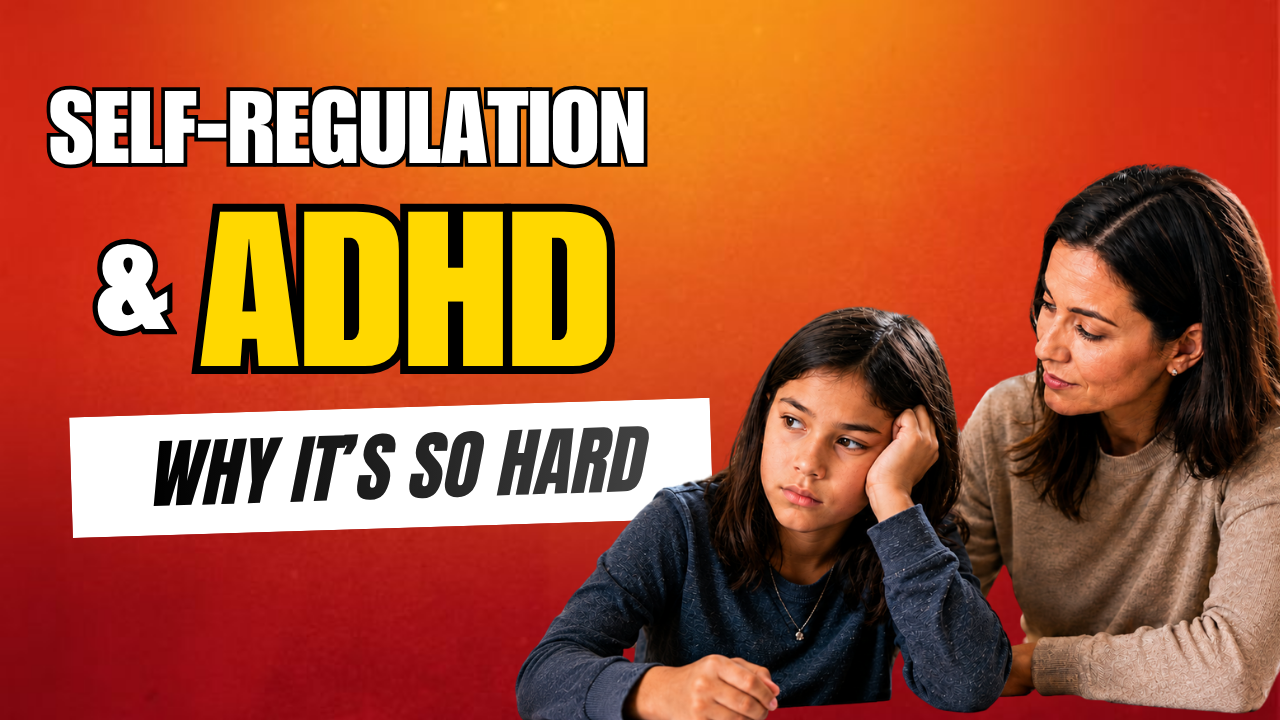
Self Regulation and ADHD: Why It’s So Hard
Aug 28, 2026If you’re raising a child with ADHD, self regulation ADHD challenges may show up in moments when something that seems simple suddenly becomes difficult.
You ask your child to get ready, and nothing happens.
You repeat yourself, and they still don’t respond.
You become frustrated. They become overwhelmed. And before long, everyone is dysregulated.
As a parent coach who helps families raising children with ADHD—and as someone with ADHD myself—I want parents to understand something important:
Your child may not be ignoring you. Their brain may simply be processing the situation differently than you expect.
When we understand that difference, we can begin adjusting how we communicate, respond, and support our children.
Here are three principles that can make a meaningful difference.
1. Remember the 5-to-1 Rule
Self Regulation ADHD Starts With Understanding Positive Interactions
Positive interactions matter for every child. But for a child with ADHD, they can be especially important.
A helpful principle is the 5-to-1 rule: aim for multiple positive interactions for every negative or corrective one.
The challenge is that what feels neutral to you may not always feel neutral to your child.
Imagine you’re trying to leave the house:
“Hey, it’s time to go.”
“Why haven’t you started getting ready?”
“I told you five minutes ago.”
“We need to get out the door.”
As the parent, you may hear four practical reminders.
Your child may experience something very different:
I’m behind again.
I messed up.
Mom or Dad is frustrated with me.
Why can’t I get this right?
That difference matters.
Children with ADHD can experience emotions and perceived criticism intensely.
Explore ADHD emotional regulation strategies for your teen to better understand how emotional responses and regulation can affect everyday family interactions.
The answer isn’t to stop giving your child direction.
It’s to become more intentional about balancing correction with connection.
Notice what your child is doing well.
Acknowledge effort.
Recognize progress.
Let them hear:
“I noticed you started getting ready without another reminder.”
“Thanks for putting your shoes by the door.”
“I know transitions can be hard. We’ll figure this out.”
These aren’t empty compliments. They’re opportunities to reinforce the behaviors and internal beliefs you want to help your child develop.
Explore positive reinforcement and ADHD behavior to learn more about how encouragement can support desired behaviors.
And yes, your child with ADHD may need more of this support than their siblings.
Fair parenting doesn’t always mean identical parenting.
Different children can need different kinds of support.
The goal is to understand the child in front of you and respond accordingly.
2. Give Their Brain Time to Process
Give Their Brain Time With Self Regulation ADHD
You tell your child something.
No response.
So you say it again.
Still nothing.
You repeat yourself a third time, and now you’re thinking:
Are they even listening to me?
Sometimes, the most useful thing you can do is simply wait.
An ADHD brain may already be processing several streams of information at once. When you introduce another request, your child may need time to shift attention, organize the information, and respond.
Explore ADHD executive function and processing time to better understand why shifting from one task or instruction to another may be difficult.
Adding more instructions before they’ve processed the first one can increase the overwhelm.
I understand this personally.
My wife can tell me something while I already have several things moving through my mind. I may hear her perfectly well but not respond immediately because my brain is still sorting through what I’m doing.
Earlier in our marriage, that silence could understandably feel like I wasn’t listening.
Eventually, we learned another way.
Sometimes I simply acknowledge her with a gesture that communicates:
“I heard you. Give me a moment to process, and I’ll come back to you.”
You can help your child develop something similar.
Maybe it’s:
“Give me a minute.”
A raised finger.
A nod.
Or another simple signal your family agrees on.
Now the parent knows the message was received, and the child gets a little breathing room to shift gears.
That small change can turn a potential conflict into cooperation.
Explore practical tips for ADHD and self regulation at home for more ways to build these strategies into everyday family life.
3. Your Regulation Helps Their Regulation
ADHD Emotional Regulation Begins With the Interaction
This may be one of the most powerful shifts a parent can make:
Your child is responding not only to your words, but also to the emotional state you bring into the interaction.
When you’re rushed, frustrated, or overwhelmed, your child often senses it.
Then their stress rises.
You become more frustrated because they aren’t responding.
They become more overwhelmed because they sense your frustration.
And suddenly you’re both caught in the same cycle.
Explore parent-child co-regulation and ADHD to better understand how a parent’s emotional state can influence interactions with their child.
The way forward isn’t perfection.
Parents have emotions too.
Instead, the opportunity is to become aware of what you’re bringing into the moment.
Before repeating the instruction again, ask yourself:
Can I slow this interaction down?
Does this truly need to happen this second?
Can I give my child a moment to process?
Can I communicate what I need without adding unnecessary pressure?
Sometimes the most effective parenting strategy isn’t another technique for controlling your child’s behavior.
It’s regulating yourself enough to create the conditions where your child can regulate too.
Explore why mindful parenting for ADHD matters for more ways to strengthen calmer parent-child interactions.
Your Child Doesn’t Need “Less Parenting.” They May Need Different Parenting.
Supporting Emotional Regulation at Home
Raising a child with ADHD invites us to become curious.
Instead of immediately asking:
“Why won’t my child do this?”
we can begin asking:
“What is making this difficult for my child right now?”
That question opens up possibilities.
Maybe they need fewer words.
Maybe they need more processing time.
Maybe they need clearer transitions.
Maybe they need more positive reinforcement.
Maybe they need you to regulate first.
You don’t have to abandon expectations or remove boundaries. You’re learning how to communicate those expectations in ways your child is better able to receive and act on.
And when you understand how your child’s brain works, you can begin building a home with more cooperation, connection, and confidence—for your child and for you.
Ready to Create More Calm at Home?
If these three principles resonate with what you’re experiencing at home and you’re unsure how to put them into practice, schedule a free 1-on-1 call with me.
We can look at what’s happening in your family and identify practical next steps that fit your child.
And if you know another parent raising a child with ADHD who could benefit from this perspective, share this with them.
Sometimes a new understanding is the beginning of a very different experience at home.
Connect with me and find out how my Emotionally Empowered Parent Coaching Program can help you to success and calm in your parenting of teens with ADHD
Stay connected with news and updates!
Join our mailing list to receive the latest news and updates from our team.
Don't worry, your information will not be shared.
We hate SPAM. We will never sell your information, for any reason.
